Le Minasha: A Luxurious Display Font for Handmade Brands
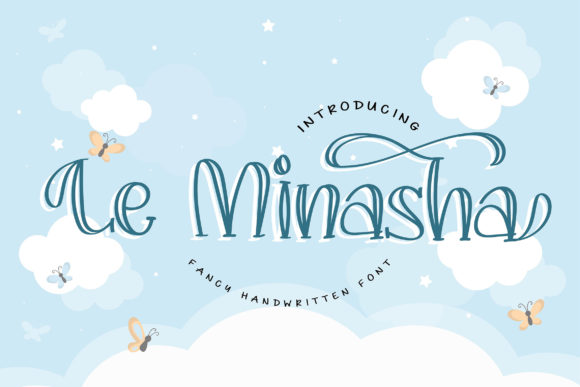
If you’ve ever held a beautifully labeled candle, admired a hand-lettered wedding welcome sign, or paused over a boutique gift tag that felt *just right*, you know how much a font can quietly shape perception. Le Minasha isn’t just another script—it’s a luxurious display font with whimsy built in, designed to elevate physical and digital craft products without sacrificing clarity or charm.
Visually, Le Minasha balances elegance and playfulness. Its strokes flow with confident curves and delicate terminals, but never at the expense of readability. It’s not overly ornate like some calligraphic scripts—no fragile flourishes that vanish when scaled down or cut on vinyl. Instead, it carries a soft confidence: think heirloom stationery meets modern farmhouse, or boutique skincare meets vintage confectionery. That balance is why it works so well across handmade contexts—from tiny sticker labels to oversized wall art.
Where Le Minasha Shines in Real Craft Projects
As someone who designs printable planner pages, cuts SVG files for iron-on transfers, and prints hundreds of greeting cards each season, I reach for Le Minasha when I need a font that feels intentional—not just decorative, but *carrying weight*. Here’s where it delivers:
- Candle & soap labels: Its open letterforms hold up beautifully at 10–12 pt on small kraft tags—even when printed on uncoated paper or embossed. Try “Lavender & Sage” or “Honey Almond” in Le Minasha over a clean sans serif body font for instant brand cohesion.
- Wedding stationery: Use it for names, dates, and headings on save-the-dates, menus, and acrylic welcome signs. The PUA encoding means you can access alternate glyphs and swashes directly—no confusing character maps. A single elegant swash on the capital “L” or “W” adds personality without cluttering layout.
- Digital printables: Planner covers, quote pages, and habit trackers gain warmth when Le Minasha anchors the title. Paired with a light-weight sans serif (like Montserrat Light or Inter), it creates visual hierarchy that guides the eye—not overwhelms it.
- Seasonal product packaging: Holiday mugs, Easter egg tags, or autumn market tote bags benefit from its approachable luxury. Unlike ultra-thin scripts that fade on ceramic or fabric, Le Minasha maintains presence at medium sizes (24–36 pt) and holds contrast well against textured backgrounds.
- Cricut & Silhouette projects: Because it’s cleanly digitized and well-spaced, Le Minasha cuts cleanly at 1.5" height on vinyl or cardstock. No overlapping letters. No fragile inner counters collapsing during weeding. That reliability saves time—and materials.
Readability Matters—Especially When You’re Selling
Let’s be practical: if your customer can’t read your product name at a glance, your design doesn’t serve its purpose. Le Minasha is designed as a display font—not for paragraphs, but for impact. It excels in short phrases, titles, names, and decorative headings. Avoid using it for full invitation text or ingredient lists, but lean into it for “Est. 2021”, “Hand-Poured in Portland”, or “The Wildflower Co.”
On mockups and previews—especially for Etsy listings—I’ve found Le Minasha reads clearly even in thumbnail size. Its generous x-height and distinct letter shapes (notice how the lowercase “a” and “e” remain legible at smaller scales) help customers instantly grasp tone and quality before they click.
Smart Pairings for Consistent Branding
No font lives in isolation—and Le Minasha shines brightest when paired thoughtfully. My go-to combinations:
- With a warm sans serif: Try it alongside Poppins, Nunito, or Lato. This pairing gives modern clarity while keeping warmth—ideal for shop logos, product tags, and social media banners.
- With a quiet serif: Play up its luxury by pairing with Cormorant Garamond or Playfair Display (light or regular weight). Perfect for high-end wedding suites or apothecary-style packaging.
- With a minimalist handwritten font: Use Le Minasha for headlines and a subtle, low-contrast script (like Quicksand or Caveat) for subheads or accents. Adds dimension without visual noise.
Avoid pairing it with other highly decorative fonts—or multiple scripts. Let Le Minasha be the statement; let supporting fonts support, not compete.
What’s Inside & How to Use It Well
Le Minasha is PUA encoded, which means all swashes, alternates, and ligatures are accessible with one click—no digging through Unicode charts or installing separate OTF files. You’ll find stylistic sets for initial caps, final flourishes, and contextual alternates that automatically adjust spacing and connection points. These aren’t gimmicks—they’re tools for refining consistency across dozens of product variations.
It comes in standard OpenType (.OTF) format, compatible with Cricut Design Space, Silhouette Studio, Adobe Creative Cloud, Canva (via upload), and Affinity apps. While it’s not a multilingual font with extended Latin or Cyrillic support, it covers basic Western European languages thoroughly—including accented characters commonly used in English, French, and Spanish product names.
A Note on Licensing—Because Your Business Depends On It
Le Minasha is a commercial font, and its license permits use in physical products (stickers, mugs, apparel), digital downloads (printables, templates, SVG bundles), and client work—as long as you’re not reselling the font file itself. That means you can confidently include Le Minasha-designed elements in your Etsy listings, Canva templates, or Shopify product mockups. Just keep your end-user license agreement handy, and always verify terms before bundling fonts into editable design assets.
For me, Le Minasha has become the quiet anchor in my brand toolkit—not flashy, but dependable. It says “handmade with care” without whispering. It looks premium on a $4 sticker and intentional on a $95 wedding suite. And most importantly, it helps my customers feel something before they even read the words: warmth, trust, and attention to detail.